
SADOWAY TARGET METAL
Consider titanium
Titanium. There isn’t another metal with such great overall properties–toughness and specific strength, light weight, exceptional corrosion resistance, and performance even at extreme temperatures.
Ti
Titanium 22
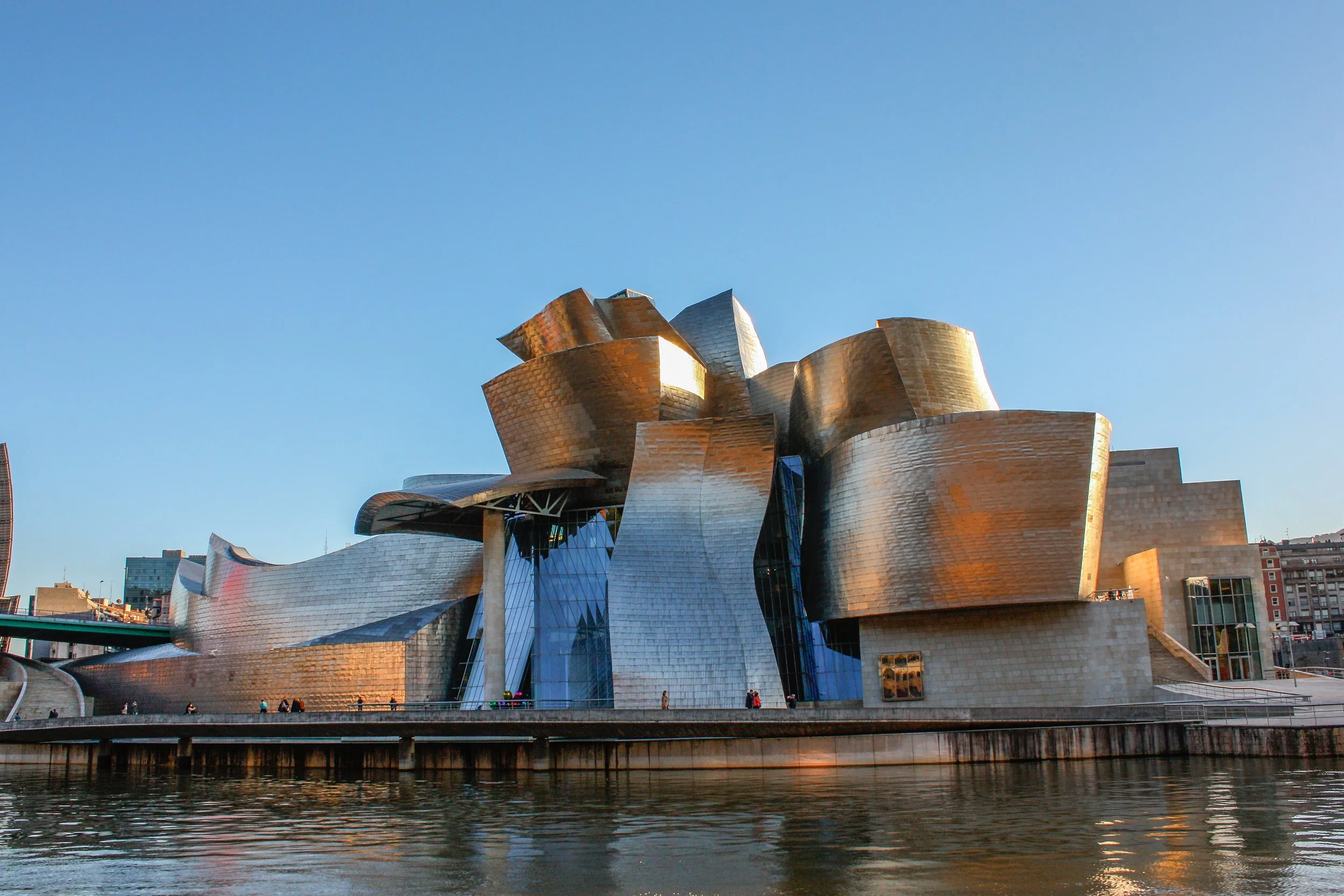
Guggenheim Museum, Bilbao, Spain
Designed by architect Frank Gehry and clad in titanium
POWERING CRITICAL MINERAL SUPPLY CHAINS
Comparison: Titanium processes
THE KROLL PROCESS
Metals are found in nature as minerals, i.e., metal compounds. Titanium, for example, occurs as rutile, which is titanium dioxide and as ilmenite, which is iron titanate. Titanium metal is traditionally produced by the Kroll Process, a chemical reaction of titanium tetrachloride with magnesium. The titanium product is termed metal sponge which must be melted to remove entrained salt. Titanium tetrachloride is prepared by carbochlorination of rutile, a process that produces toxic dioxin as a byproduct. The tetrachloride is subjected to multiple distillation steps to rid the feedstock of impurities. Such a facility comes with high CapEx, runs with high OpEx and generates high levels of pollutants.
The process of turning rutile or ilmenite into titanium is fundamentally difficult and the many steps involved in the Kroll process adds to the cost. The Kroll process for titanium has changed little since the 1950s. There is a better way.
The Kroll faces these challenges:
Huge facility spanning large area
Long permitting time
High labor intensity
Batch process with long cycle time (~12 hours)
Yield discrete batches-not continuous flow
High level of impurities
Tremendous energy cost
High carbon intensity
Huge waste
THE SADOWAY PROCESS
Consider a process in which titanium dioxide is dissolved in a solvent composed of a solution of other metal oxides into which are immersed two electrodes. By the action of electric current the titanium dioxide is decomposed into liquid titanium which pools on the bottom of the cell and into oxygen which vents through the top of the cell. No Kroll reactor, no carbochlorinator, no vacuum arc remelting furnace.
In one step we move from dirt to liquid metal of requisite purity, and at or below the market price point. One-pot smelting. Processing compression.
High-temperature electrochemistry is a platform technology that can be adapted for processing other ores and converting them into their respective metals, e.g., titanium, antimony, scandium, beryllium, vanadium, and rare earths (neodymium and samarium).
The processing compression in Sadoway High-Temperature Electrolysis significantly reduces the number of steps with attendant savings in CapEx and OpEx—power, CO2 emissions, footprint-- as well as labor, equipment, transportation, permitting time, and related expenses. .
Two buildings: extractory and refinery.
Each building holds 10x10x10’ cells in 2x2 rows.
Yield continuous flow which translated into exceptioinally high space-time yield
Zero to no waste or emissions
Comparison: Kroll process v. Sadoway process
One metric tonne output of titanium
Smelter land requirement
75 acres
Kroll process
Sadoway process
1 acre
Kroll process requires over 75 acres per one tonne annual output. Sadoway process requires ~1 acre per one tonne annual output.
CO2 emissions
28 tonnes
Kroll process
Sadoway process
.919 tonnes
C02 emissions per one metric tonne output of titanium.
Kroll process produces 28 tonnes or 28,000 Kg. Sadoway process produces 0.919 tonnes or 919 Kg.
Power cost
Kroll process
Sadoway process
$40
$3,585
Cost for power--assumes .05¢ KWh or $50 MWh.
PROOF OF CONCEPT
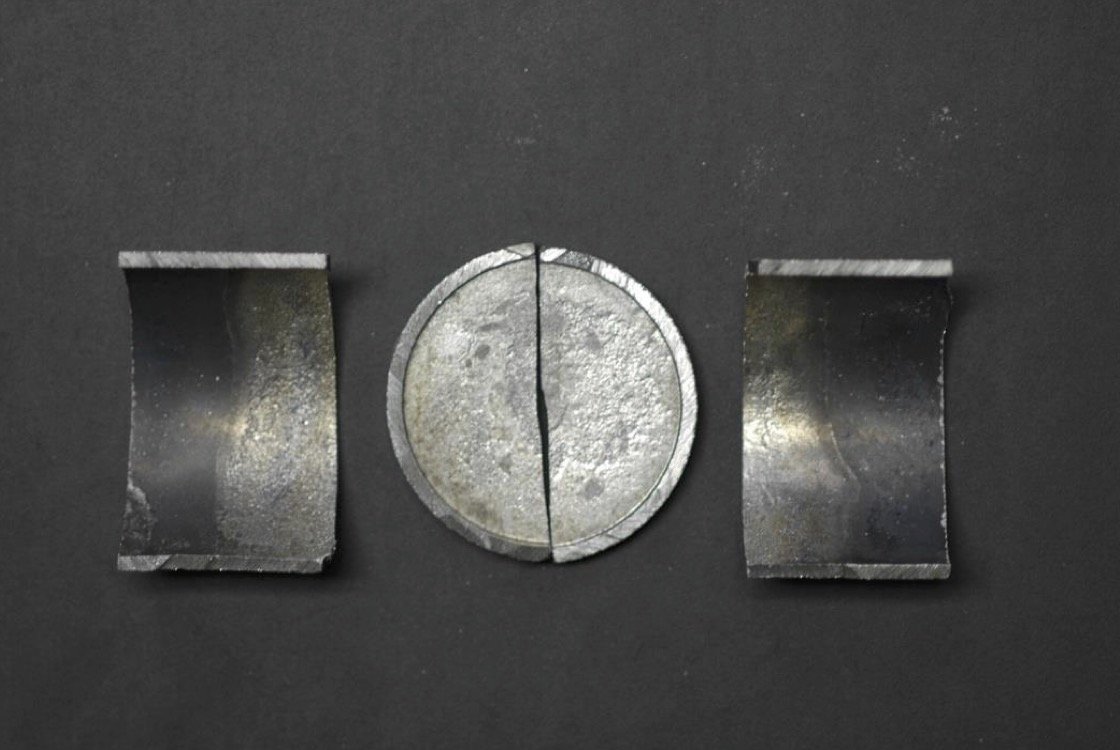
Titanium experiments carried out at MIT and 22Ti
An image of titanium pooled on the bottom of the crucible
Work performed in 1999 by Prof. Sadoway at MIT and the titanium start up 22Ti, is evidence of conversion of rutile into liquid titanium by molten beryllate electrolysis.
Experimental conditions
Melt- BeO 42%(mol), CaO 28%(mol), TiO2 30%(mol)
Cathode – Mo rod
Anode- Carbon rod
Electrolysis carried out at 1700℃ in a Mo crucible. A constant current of 10A was passed through the cell over 4-hr period. Cell voltage remained between ~0.9-1.1V throughout the run.
Observations
Silver colored deposit was observed in the bottom of crucible.
Analysis
Crucible surface and the melt were analyzed by EDX and XRD. Both methods indicated the presence of liquid Titanium.
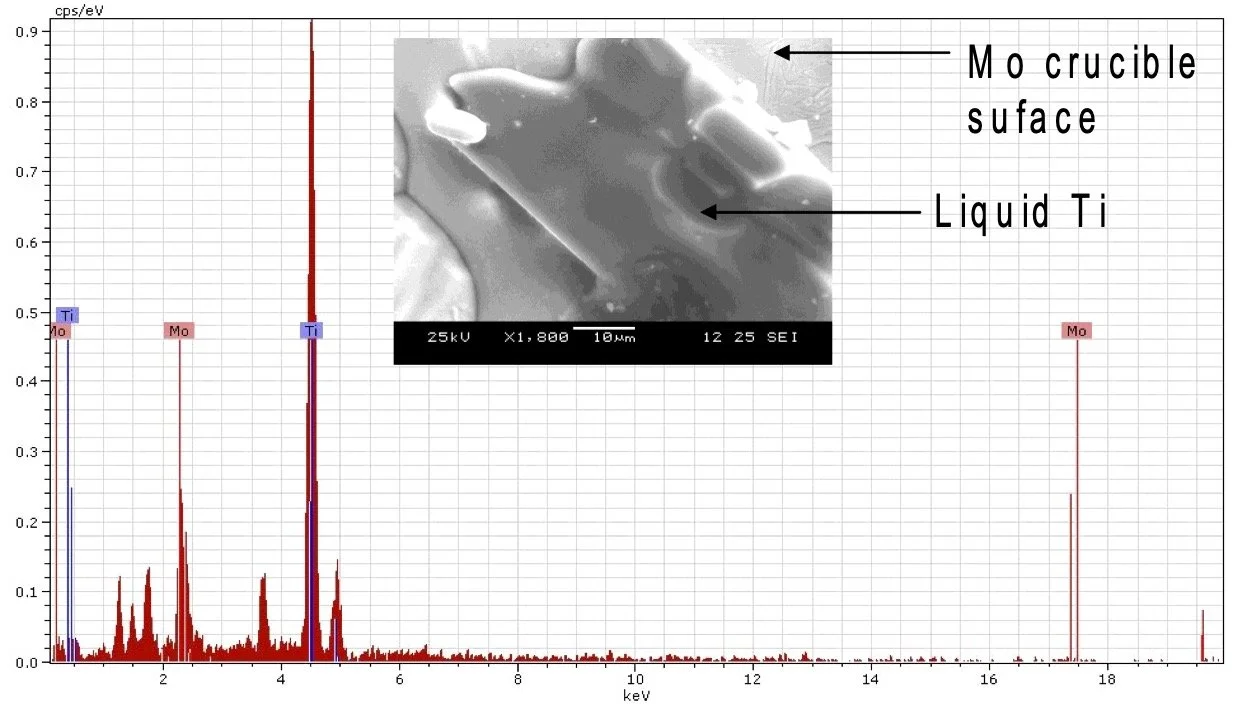
SEM-EDX analysis of the bottom
WHY IS THIS IMPORTANT?
Producing titanium without the Kroll process saves cost of power, smelter, labor, and time.
In one step, we moved from dirt to liquid metal of requisite purity, well below below the market price point. One-pot smelting without CO2 emissions and the by-product dioxins.