

SADOWAY TARGET METALS
Consider rare earths
Nd
Neodymium 60
Y
Ytterbium 39
Ho
Holmium 67
Ce
Cerium 58
Tb
Terbium 65
La
Lanthanum 57
Pr
Praseodymium 69
Dy
Dysprosium 66
Lu
Lutetium 71
Ga
Gadolimium 64
Sc
Scandium 21
Tm
Thulium 69
Er
Erbium 68
Sm
Samarium 62
Eu
Europium 63
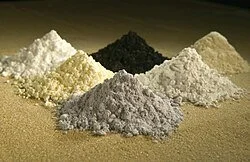
The rare earth metals (REEs) comprise a set of 17 elements on the periodic table comprising the 15 lanthanons plus scandium and yttrium. They are essential for advanced electronics, magnets, and green technologies. The term "rare-earth" is a misnomer, because they are not actually scarce, but because they are found only in compounds, not as pure metals, and are difficult to isolate and purify.
PROOF OF CONCEPT
Rare earth experiments carried out at Sadoway Labs
Based on work directed by Prof. Sadoway at Sadoway Labs Foundation we obtained first indication of proof-of concept for conversion of neodymium oxide into primary metal by molten borate electrolysis.
Consider a process in which neodymium oxide (Nd2O3) which is found in rare earth ores is dissolved in a solvent composed of a solution of metal oxides into which are immersed two electrodes. By the action of electric current neodymium oxide is decomposed into liquid neodymium which pools on the bottom of the cell and into oxygen which is ducted through the top of the cell. No leaching with sulfuric acid, no solvent extraction, no CO2.
Rare earth ores commonly contain a plurality of rare earth metals. Separating rare earth metals from one another is extremely difficult owing to their nearly identical chemistries: nearly identical electronic structures which means nearly identical chemical behaviors. Each target rare earth metal presents its own set of challenges owing to the specific composition of the ore body which dictates the impurity profile.
Experimental conditions
Melt- NaF 15 wt %,B2O3 70 wt %, Li2O 5 wt %, Nd2O3 10 wt %
Cathode – graphite crucible
Anode- suspended graphite rod
Electrolysis carried out at 725℃.
Moving forward, the process will run at >1075℃ which puts it above the melting point of neodymium and enables production of primary liquid metal.
WHY IS THIS IMPORTANT?
Separation of target metal which is the basis for refining to high purity resorts to a variety of techniques: some electrochemical, e.g., electro refining by Hoopes-Gadeau, some physical-chemical techniques such as fractional distillation of the vapors of metal halides, or metal chalcogenides, or directional solidification for impurity segregation, and others.
In one step we move from dirt to liquid primary metal which is subjected to a bespoke regimen of refining steps. One-pot conversion from dirt to primary metal. Processing compression.